“The standard way to make an action movie that we learned was, you usually have three set pieces. One in the first act, one in the second, one in the third. You spend most of your money on that one in the third act. That’s your finale. And now they’re like, ‘Can we get a big one in the first five minutes? We want people to stay. And it wouldn’t be terrible if you reiterated the plot three or four times in the dialogue because people are on their phones while they’re watching.” – Matt Damon on Netflix
“And it’s important to say it out loud because the discipline and the work ethic I’m bringing to these things — I don’t want people to take it for granted. I don’t want to take it for granted. This is really some top-level shit.” – Timothee Chalamet
“I really enjoy seeing. I guess my favorite thing in life is the fact that I can see. It’s just so unbelievable.” – Diane Keaton
“May cinema never lose its capacity to amaze and even continue to offer us a glimpse, however small, of the mystery of God.” – Pope Leo XIV
Staring down the barrel of yet another post about the year’s best films, I’m confronted by that old familiar feeling: “What the hell was that?” 2025 was, by all accounts, another doozy. In some ways, a January that gave us One of Them Days and the dirtbags of DOGE feels miles apart from a December that gave us Marty Supreme and the horrors of ICE. But in other ways, it all feels like part of the same endless grind — one cruel policy after another, one rent hike after another, one elevated horror film after another.
So, while our country continued to slog its way through a mire of our own making, at the movies it was also another year of upheaval inside and outside the theater. Warner Bros. stands on the precipice of being gobbled up by a Saudi-backed, MAGA-curious, nepo exec. A24 bought a theater, like an actual theater-theater. Mubi took some Sequoia cash (and suffered the consequences). James Cameron pushed the limits of what’s possible, while Netflix continued to push the limits of what’s palatable.
Meanwhile, on the just-barely-bright side, it feels like maybe, just maybe, Hollywood’s superhero fever started to break. After Captain America: Brave New World took Harrison Ford’s career to brave new lows, and Fantastic Four: First Steps sent Pedro Pascal’s career back a step, around the edges, you started to see studios get back to some of the riskier, adult stuff that was their bread and butter in decades past. Relationship drama (Materialists), sports drama (F1), even a big studio action parody (The Naked Gun, a remake, but still). While perhaps most importantly, some of the top films on this list are original, auteur-driven swings that cleaned up at the box office (Sinners, Marty Supreme, One Battle After Another).
In terms of a through-line to unite so many of the year’s best films? It was a preoccupation with the next generation. What kind of world are we leaving for the kids? One Battle After Another confronted the generation gap among revolutionaries. Marty Supreme closed on Chalamet’s bemused expression as he reckons with his newborn. Sorry, Baby literally ends with an apology to a baby (hence, the title). Filmmakers in 2025 were wringing their hands over the state of the states, and responding in the only way they could: with a three-hour masterpiece where Leonardo DiCaprio ultimately accepts that the resistance and selfies can coexist.
In the end, 2026 proved that movies can still hold their ground in the cultural conversation. They inspire memes, and essays, and backlash to the backlash. They challenge and comfort. They inspire and recontextualize. So, without further ado, here are a few that did just that:
(As always, it’s inevitable that some great films will be left off this list. Between the films I haven’t seen (Sirat, No Other Choice, Train Dreams) and the films I should’ve skipped (The Mastermind, Highest 2 Lowest) — this isn’t definitive. It’s just one guy’s musings, haphazardly complied while off-camera on a Zoom call.
The List:
11) Sinners: Look, there’s no getting around the Marvel-ization of the third act. A giant karate fight (when did Annie learn to do a drop kick?), four or five different endings, and a post-credits scene to set up the next adventure. Also, if I’m honest with myself, the sequence that some viewers are praising as transcendent, feels more like something a marketing agency would spin up for Folkways. Yet, despite those elements, there’s no denying that Sinners makes an impact. The sense of place (and pace) in the first hour immerses you completely in the intricacies and histories of the town. And just as important, this was a big, studio-backed swing that paid off. Michael B. Jordan and Ryan Coogler are out here trying to save cinema, hope someone continues to let ’em do it!
10) Cover Up: This spot is basically a stand-in for all the incredible docs of the year: Alabama Solution, Perfect Neighbor, Apocalypse in the Tropics. But the reason I’m singling out Cover-Up is as much to do with the fascinating story of Seymour Hersh and his commitment to investigative journalism as it is about the woman behind the camera, Laura Poitras. Poitras is responsible for two of the greatest films of the century so far, Citizen Four and All The Beauty and Bloodshed. She deserves to be in the conversation of great filmmakers. Does Cover-Up rise to that standard? Not quite. A riveting first hour gets hurried and piecemeal in the back half. Still, it’s an essential piece from a director at the peak of their powers.
9) Phoenician Scheme: I don’t think it’s a coincidence that the finale of Phoenician Scheme features a room littered with hieroglyphics. Wes Anderson’s style has become its own sort of ornate, symbology. And just like hieroglyphics, his films can be superficially scanned for aesthetic beauty, or, with the right translation, reveal their deeper meaning. Phoenician Scheme is a film about the person we present to the world vs. the person we are at our core. It’s fellow imposters coaxing one another out of their personas — the non-believer under the nun’s habit, the American spy under the Swedish accent, the working class cook hidden inside the international swindler. We spend so much of our lives building up the artifice, trying to bend the world around us into a helpful shape, but Anderson wants us to never forget the person putting on the hair tonic. People are just people are just people, no matter their presentation.
8) Wake Up Dead Man: A Knives Out Mystery: In an alternate universe, these films are exactly what Johnson’s worst critics say they are: needlessly convoluted puzzles that rely on stock characters and gimmicky reveals. But in this universe, Wake Up Dead Man, like all the best genre films, uses the comforts of the form to sneak in nuanced ideas about taboo subjects. Is devotion a salve for the grieving or a tool for the power mad? Does faith embolden our highest ideals or our worst impulses? Johnson wants you to wrestle the most profound questions of religion and redemption…or you can just try to figure out who murdered who. It’s pretty good for that too.
7) Bugonia: More than any other film in recent memory, Bugonia took me inside the folds of one of those conspiracy-addled, homebodies that you think live on the outskirts of town but are increasingly vaping in the apartment next door. Jesse Plemens completely inhabits the contradictions of a devoted, soft-spoken protector and a murderous, zombified tragedy. The brilliance of the film lies in how much you can’t decide which one of these personalities is justified. All the typical Yogos-ian touches are there — mutilation, ritualized oddity, Emma Stone. But even at its bleakest (and the ending can’t get any bleaker), I was riveted.
6) Black Bag: Sometimes you just want a perfectly executed spy thriller with two of the best actors in the world trading pointed glances at one another. And the editing during that interrogation scene, I mean, c’monnnnnn. Also, justice for Marisa Abela. She was given a raw deal with that mediocre Amy Winehouse movie, but she’s incredible on Industry and fantastic here. If Villenueve knew what was good for him, he’d cast her as the femme fatale in the next Bond movie. Instead, it’ll probably be whatever Bvlgari model they can snag at scale.
5) Sorry, Baby: An MFA program at a small liberal arts college, crying in bathtubs, baby animals as metaphor for emotional rebirth — Sorry, Baby could easily have been another over-considered and under written Sundance hit. The kind of movie that plays well with a crowd of like-minded festival crawlers but doesn’t quite carry beyond the Park City lines. The difference here is Eva Victor. Somehow they’re able to deliver every monologue and stray aside with the perfect dose of feeling. The only downside of a debut this good is it set an impossibly high bar for what comes next.
4) 28 Years Later: Compromise is a strange concept when it comes to film. It’s rare, if not totally non-existent, for a movie to be made without any compromise. If anything, the very nature of film forces compromise and that tension is the artistry. It’s a collaboration between hundreds, sometimes thousands, of individuals each chipping away at their tiny corner of a project. There are budget constraints, time constraints, and all the invisible constraints we erect in our mind about what can and should be included – call them constraints of expectation. So, it’s all the more rare (and exciting) to see a film that, even if it had to contend with all of the above, feels completely out on its own. 28 Years Later is that. Skittering camera work, iodine Ralph Fiennes, slug zombies! This was Boyle breaking expectations over his knee.
4) Roofman: Can I do ties? At this point who cares? Especially when there’s a film as deserving (and underrated) as Roofman. Don’t be fooled by the goofy details (Toys R Us, McDonald’s robberies). This is one of the sharpest films of the year. Tatum and Dunst give such subtly heartbreaking performances. The descriptor “lived-in” gets tossed around a lot, but that’s the best word for it. There’s so much texture and…humanity. I keep thinking about the first time Channing Tatum is arrested. The police pushing him down in long grass, the blades getting in his mouth. Humiliation and resignation shattering across his face. It’s seared into my memory.
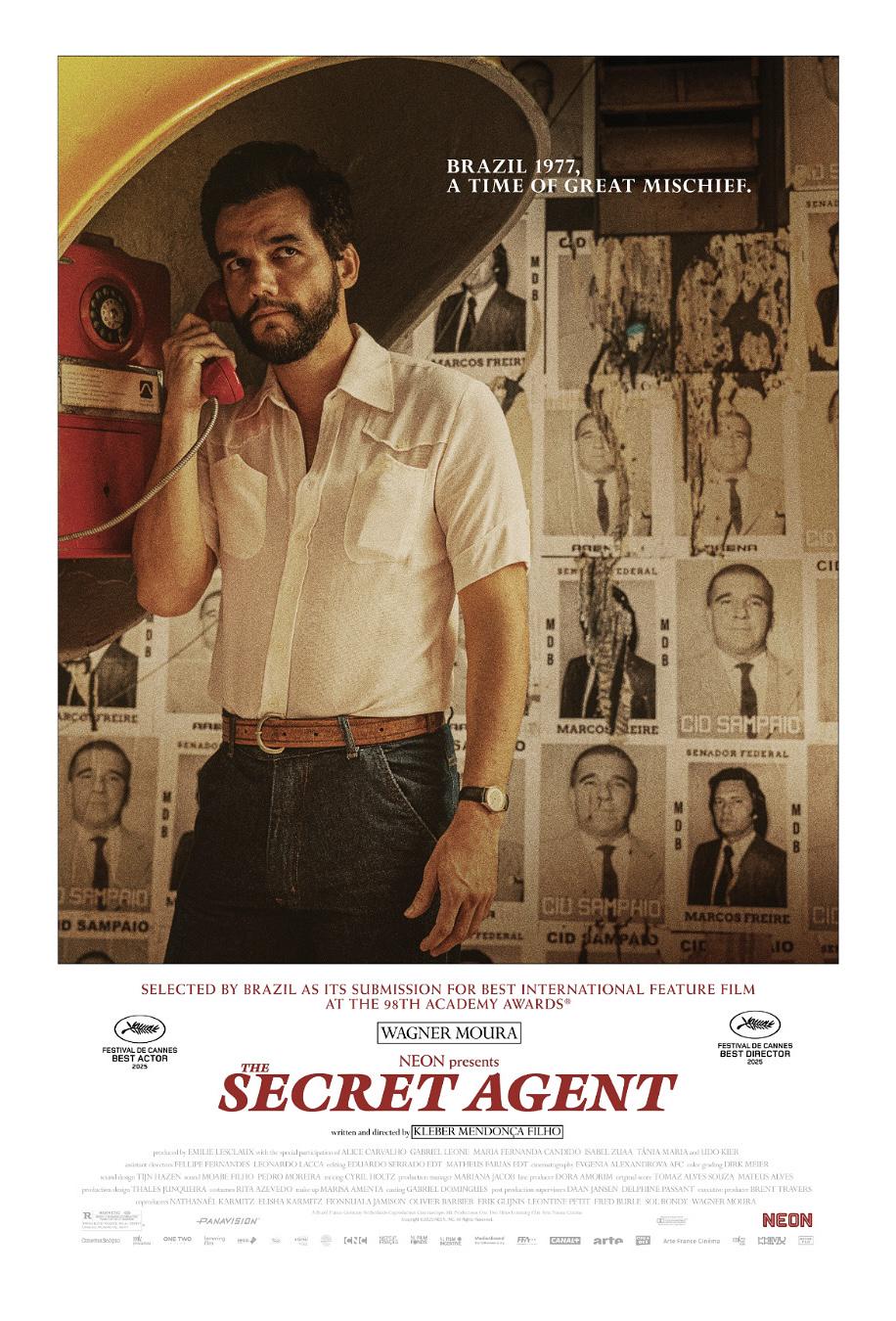
3) The Secret Agent: A great opening scene is a double edged sword. On the one hand, it’s an immediate hook that can set the table for what’s to come. On the other, it can set a bar so high that everything after feels like a shadow. Thankfully, The Secret Agent opens with one of the tensest, most perfectly paced sequences of 2025, and everything that follows keeps building. The film is a heady mix of hyper-specific period colors and details stirred together with the elemental storytelling of Old Hollywood. (Did the home for refugees remind anyone else of the hotel in Casablanca or To Have and Have Not?) There’s a classicism that holds this whole thing together. I could’ve watched another three hours.
2) Marty Supreme: Between Uncut Gems, Anora, and Caught Stealing, there’s a thriving subgenre in the indie film world — high-intensity stories set in NYC featuring propulsive camera work, street casting, and at least one scene of a goon dragging someone kicking and screaming down a hallway. Maybe we call it NY Nico Core? The thing that Marty Supreme does differently is its period. Have the 1950s ever felt this fucking out of control?? The backgrounds are teeming with extras. The score lifts every action. It’s maximalist filmmaking with care and attention paid to every mustache and bowling ball. I’ve been thinking a lot about the final scene — Marty at the hospital. seeing his son for the first time. Is it a wake-up call to maturity? The weight of consequence crashing down? Maybe it’s a total reorientation in real time? Maybe it’s immediate allegiance to a new way of living? Or, more likely, is it all those feelings at once? No clear answer. Just an athlete devoted to competition, confronted with a game he can’t win, and rules he doesn’t know.
1) One Battle After Another: The best cut of the year has to be when we land on Chase Infiniti methodically doing karate as Dirty Work plays right? “Sixteen years later, the world had changed very little.” The line isn’t just a thesis for the film, but it’s a deep existential acknowledgement about the cyclical nature of revolution and retrenchment. Things blow open and come back together. Protestors take two steps forward before they’re pushed two back. That cut is just one of the many incredible magic tricks that One Battle pulls off throughout its three hours. It makes every single moment feel high stakes, second by second, pursuit by pursuit. While at the same time, balancing all these small actions against the long view of history.
The screenplay is full of visual rhymes. (The grandmother says her daughter is a runner. In the next scene, she’s running. The grandmother says her son-in-law is a stump. A few scenes later, he escapes through a tree stump.) The action sequences are gorgeous. (Those rolling hills, lulling you into a dream state, only to shake you awake). But, more than any of that, this was the rare movie where the emotions felt stronger the second time seeing it in the theater. The characters are so finely drawn that even in the most absurd scenarios, you feel completely immersed in their perspectives. You rise and fall as they do. You hold your breath every time they step in harm’s way.
When we look back at 2025, we might point to One Battle After Another as a perfect example of an auteur responding to the social and political crisis of the day. We might talk about the film as one of the last examples of the studio system delivering a modern, original story on an epic canvas. We might point to it as Leo’s crowning achievement, or PTA’s, or the thing that launches Chase Infiniti. But in the end, whatever we say, we’ll still be talking about it.
Superlatives and such
Jude Law 2004 Award: Josh O’Connor 2025. Remember the year Jude Law was in so many movies that Chris Rock made a joke about it at the Oscars? It was a pointed enough joke that it got a humorless response from Sean Penn. Well, let’s see what Conan does with Josh O’Connor this year because everyone’s favorite British pool noodle was in four, count ’em, FOUR films in 2025. Rancher? Check. Priest? Check. Pianist? Check. Art thief? Check. He basically filled out his whole headshot in one go.
Best Bad Teeth: The cast of The Secret Agent. Sometimes the authenticity of a performance can be found in an actor’s mannerisms, or their demeanor, or their accent. Sometimes, it’s lining their gums. If you’re trying to recreate 1970s Brazil, nothing takes an audience out of the era faster than a sparkling pair of chip-free choppers. Thankfully, the film’s cast embraces the truth of the world—stains, snaggles, underbites and all.
Tootsie Award for most random film I rented on my in-laws Amazon account: Age of Disclosure. About three years ago, my wife’s mother was checking the charges on her Amazon account when she saw something suspicious. There was a $5.99 rental charge for the 1982 Sydney Pollack film Tootsie. So, she got customer service on the phone and insisted that she’d been hacked. The rep then asked if someone else in the family could’ve done it. And my mother in-law reportedly replied “no one in my family would ever rent the movie Tootsie“. Well, she was half right…because it was me. Her son in-law. I rented Tootsie.
What can I say? My wife is logged in to a joint account with her parents on our TV. And when the desire to watch Tootsie overcame me, I indulged. Now, has this experience stopped me from renting random movies on their account? Alas, no. So, I can only imagine how perplexed my in-laws were when they recently received a $15 charge for the extremely middling alien conspiracy doc Age of Disclosure…..if I’m left out of the inheritance, I guess I know why.
Thinnest Skin Award 2025: Paul Dano’s co-stars. It’s a sad commentary on the state of the hollowed out media landscape that a stray comment from a film director on a podcast can create a week’s worth of articles from the major film trades. But that’s exactly what happened when Tarantino causally insulted the actor Paul Dano. Now, to his credit, Paul Dano handled the situation the way any normal, busy adult would when someone they’ve never worked with makes a glancing comment about you…he did nothing. He was probably busy, you know, living his life. But Paul Dano’s former co-stars on the other hand….watch out! They just couldn’t resist a chance to virtue signal themselves into social media heaven. Public praise from Matt Reeves. Josh Gad, Ben Stiller. Hell, Daniel Day Lewis doesn’t even have a a smart phone or social media, but somehow released a statement of support (or, well, supported a statement of support). Using your platform to advocate for the humanity of refugees? Meh. Using your platform to save another A-lister from mild insult? Stand tall Hollywood! Makes Aaron Sorkin tsk-tsking the New Yorker look like child’s play.
Rocket Man Award for Phallic Symbolism: One Battle After Another. Even for PTA (a filmmaker who’s made films about a guy with a huge dong, and another about erupting towers) this movie is pushing the bounds of penal metaphors. Penn’s girthy cigars, DiCaprio’s micro joint. The police batons, lined up, erect and ready to go. The blast cap. The guns, of course. A recurring theme in all of PTA’s work is carnality as catalyst. So, much of the violence in this world is driven by men and their sexual frustrations. And in One Battle After Another, PTA makes sure you’re exposed to all of it.
Take a Gap Year! If I can encourage one thing as we barrel over the falls of 2026, it’s to take a gap year. And by gap year, I mean find a random best films ever list and start filling in your filmic gaps. Never seen Sunset Boulevard? Fire it up. Been meaning to watch a Bergman film, any Bergman film? Go for it. Your boss loves Heat? Try it before the sequel comes out. I took a gap year in 2025 and it was great (and enlightening and tiresome and weird). Clueless, Some Like It Hot, Before Sunset, Brazil (just a few I saw for the first time) — there’s so much good stuff out there. You might have your mind set ablaze, or at the very least get Julie Delpy on the ukulele.
Alright, we did it. As always, thanks for reading. Thanks for cleaning up after your dog. Thanks for holding the door open when you see me struggling with a stroller. But most of all, thanks for going to the movies. See you on the other side of 2026.
Later,
Will


 grain&noise